
Search Dakota County Court Records
The official online court records route is Minnesota Court Records Online Case Search, usually called MCRO. MCRO is statewide for Minnesota District Court records, so Dakota County cases appear beside other county results unless Dakota is selected as a court location filter. It provides Case Search, Document Search, Hearing Search, and Judgment Search. MCRO results are useful for case numbers, parties, filed dates, case status, docket entries, public documents, hearings, and docketed money judgments. They are not certified court records.
The best search path depends on the starting fact. A name search works when the person or business name is known. A case-number search is more precise when a Dakota County file number is available. Citation-number search is useful for traffic and petty misdemeanor matters. Attorney search can help when a lawyer or Minnesota license number is the known link. For certified copies, case records not shown online, or older files, Dakota County District Court Administration is the local office to contact.
- Open MCRO Case Search and accept the terms. The terms explain that online records are unofficial.
- Choose Name, Case Number, Citation Number, or Attorney. Use the tab that matches the best known fact.
- For a name search, enter the last name and add first name, middle name, date of birth, filed-date range, case category, and status if known.
- Select Dakota County from the court locations filter when statewide results are too broad.
- Open the result and review the Register of Actions, hearings, documents, judgment data, and case status.
- Use Document Search by case number when a public document is available for online download.
- Contact Court Administration when a certified copy, courthouse-only record, or pre-online document is needed.
The MCRO Case Search portal shows the search choices used for Dakota County court records.
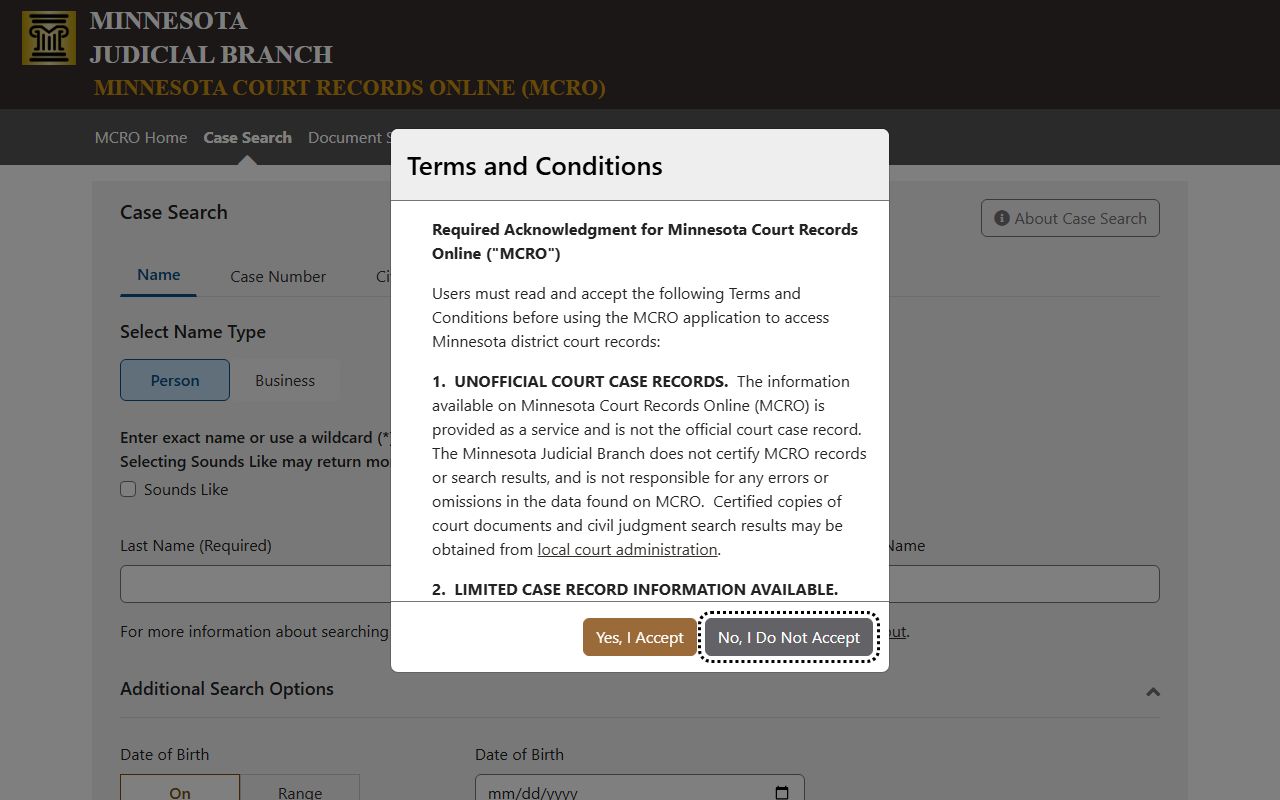
Those tabs matter because the same Dakota County case may be easier to find by name, case number, citation number, or attorney depending on the record type.
Dakota County Court Records Fields
MCRO search fields are built to narrow a statewide database down to a Dakota County District Court result. A broad last-name search may return many cases from many counties. Adding date of birth, filed-date limits, case category, active or inactive status, and Dakota County as the selected court location reduces false matches. Wildcards can help when a name spelling is uncertain, but the MCRO terms warn that a wildcard cannot be used with the Sounds Like option.
| Field Label | Type | Required | Notes / Format |
|---|---|---|---|
| Search tab | Tab or radio | Yes | Name, Case Number, Citation Number, or Attorney. |
| Select Name Type | Radio | Conditional | Person or Business. |
| Sounds Like | Checkbox | No | May return more results; wildcards are not allowed with Sounds Like. |
| Last Name | Text | Conditional | Exact name or trailing wildcard after two characters. |
| First Name | Text | No | Narrows a person-name search. |
| Date of Birth | Date range | No | Use an exact date or range when known. |
| Date Filed | Date range | No | Limits results by filing date. |
| Case Category | Filter | No | Civil, Criminal, Family, Probate or Mental Health. |
| Case Status | Filter | No | All, Active, or Inactive. |
| Court Locations | Selector | No | Select Dakota County to narrow statewide results. |
The MCRO Document Search portal is the related tool for public documents once a Dakota County case number is known.
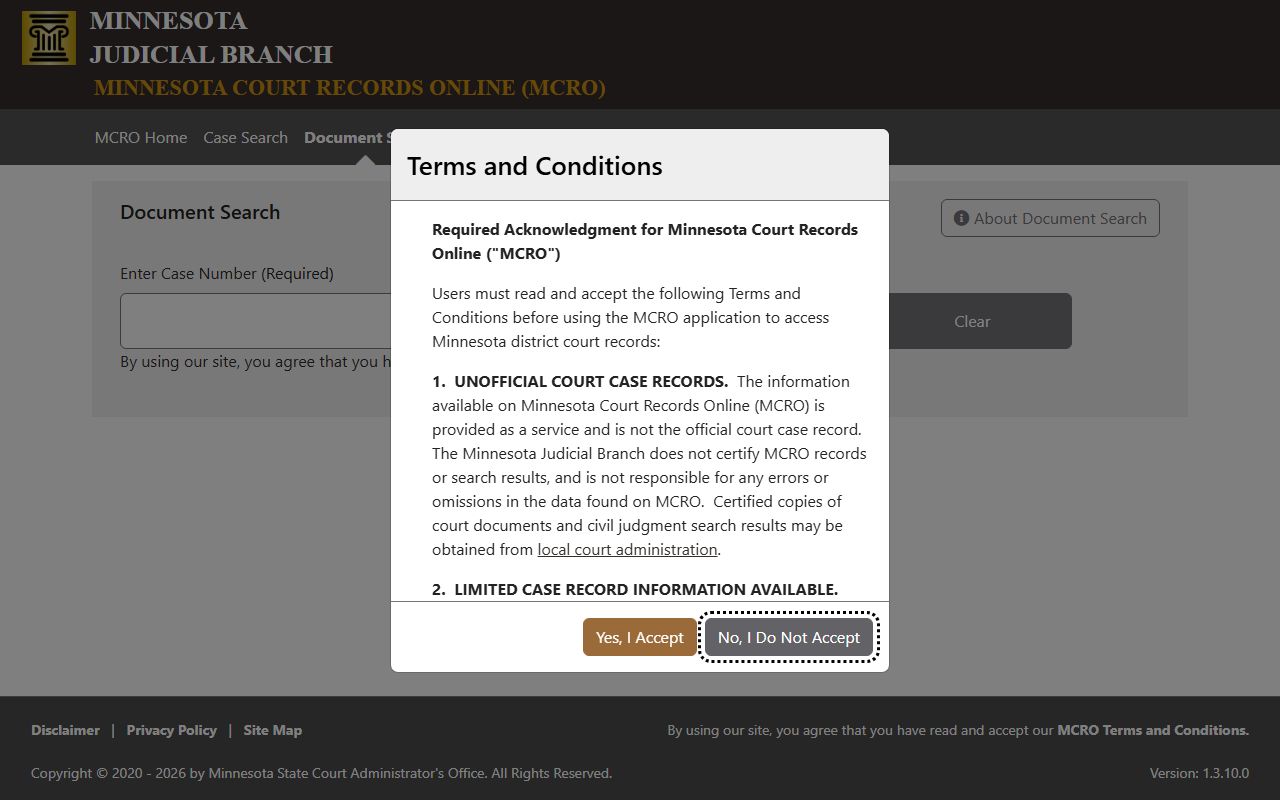
Document Search is narrower than Case Search, but it is the right route when the task is to find an available pleading, order, or other public filing by case number.
Dakota County Court Record Types
Dakota County District Court has original jurisdiction over civil, family, probate, juvenile, criminal, and traffic cases filed in the county. That means most local court records are not split among separate county courts, justice courts, or municipal trial courts. City police may issue citations, and county offices may hold county data, but the court case is filed in District Court. Small claims are handled as conciliation court matters within District Court, and traffic or petty misdemeanor cases are still court records even when payment can be made through Minnesota Court Web Payment.
Common Dakota County court records include civil complaints, answers, motions, affidavits, court orders, judgments, divorce and custody files, paternity and child-support records, probate estates, guardianship or conservatorship matters, criminal complaints, sentencing orders, probation terms, traffic citations, conciliation claims, and eviction cases. Family, juvenile, protective-order, and mental-health records have stronger restrictions than ordinary civil or adult criminal files. A record may be public at a courthouse terminal but not available through internet access.
- Civil records include complaints, motions, affidavits, orders, judgments, and docketed money judgments.
- Criminal records include complaints, charges, pleas, hearings, dispositions, sentencing orders, probation terms, and warrant events.
- Family records include divorce, custody, paternity, parenting time, child support, and some protection matters with remote-access limits.
- Probate records include estates, guardianship, conservatorship, trust, and probate-hearing entries.
- Traffic records include citation, petty misdemeanor, and adult traffic case information held by District Court.
- Conciliation and eviction records are civil District Court matters with their own case prefixes and hearing types.
The MCRO Judgment Search portal supports Dakota County court records research when the issue is a docketed money judgment.
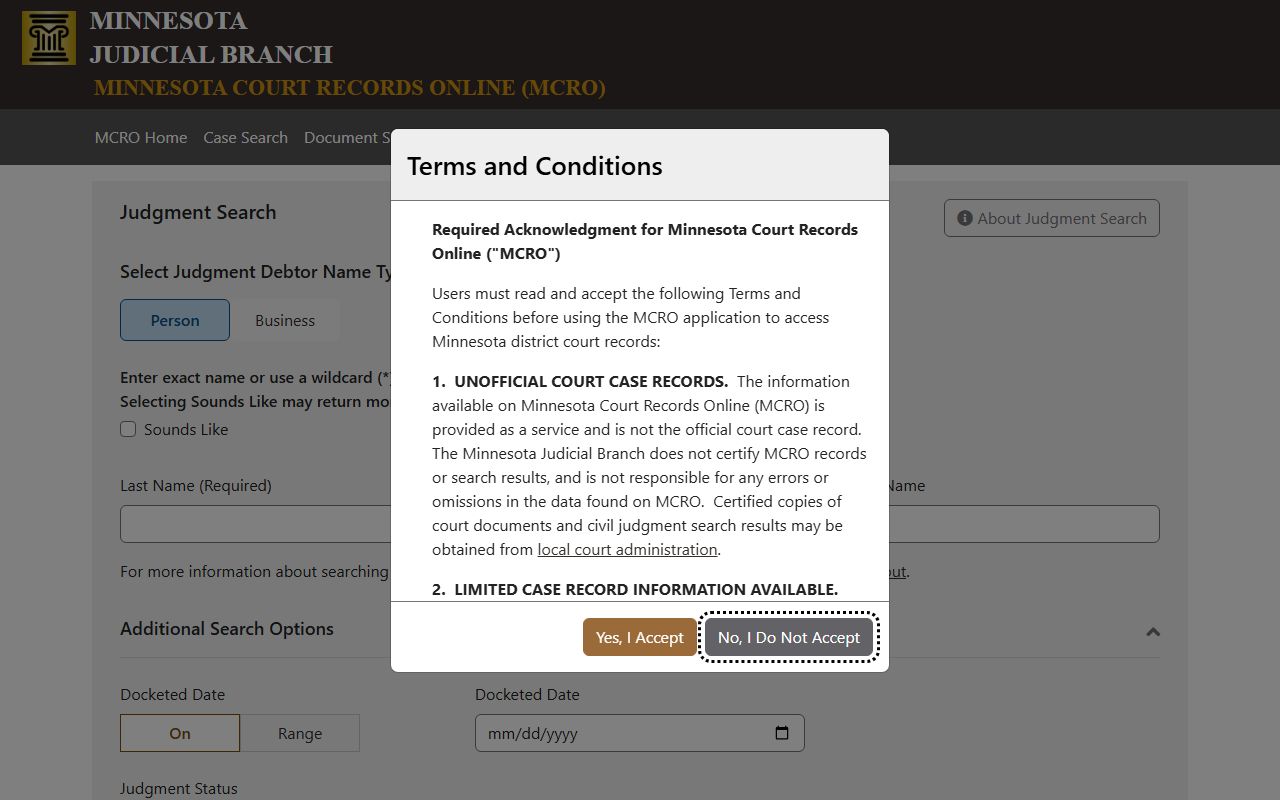
Judgment Search is separate because money judgments are often searched by debtor name rather than by ordinary case lookup.
What Dakota County Records Show
A Dakota County court record usually combines identifying case data with a chronological Register of Actions. The case number shows the county/location prefix and case type, such as CR for criminal, CV for civil, CO for conciliation, PR for probate, or VB for traffic/petty matters. Calendar samples show Dakota County location prefixes such as 19HA, 19AV, and 19WS. Party roles vary by case type: plaintiff, defendant, petitioner, respondent, decedent, debtor, creditor, attorney, or business entity.
| Field | What It Shows |
|---|---|
| Case number | Dakota County District Court location prefix, case type, year, and sequence number. |
| Court or location | Judicial Center, Western Service Center, Northern Service Center, courtroom, or hearing office. |
| Case category | Civil, Criminal, Family, Probate or Mental Health, traffic, conciliation, or related type. |
| Parties | Names and roles such as plaintiff, defendant, petitioner, respondent, decedent, debtor, or attorney. |
| Register of Actions | Chronological entries for filings, hearings, orders, dispositions, notices, payments, and warrants. |
| Documents | Available public filings, orders, and other downloadable documents when MCRO remote access allows. |
| Hearings | Date, time, judicial officer, hearing type, location, role, and case number. |
| Financial entries | Fines, fees, restitution, court costs, bail, judgment amount, and satisfaction entries where applicable. |
| Restrictions | Redactions, sealed status, nonpublic documents, and items not shown remotely. |
These fields are not all proof of final outcome. A filed charge is not the same as a conviction, a scheduled hearing may change, and a document that appears in one case type may be hidden in another. Certified copies and civil judgment search results come from Court Administration, not from a screenshot or downloaded unofficial result.
Dakota County Court Access Rules
Dakota County court records sit under Minnesota court-record access rules. County administrative data is governed by the Minnesota Government Data Practices Act, which presumes government data are public unless a law makes them nonpublic, private, or confidential. Court files have their own public-access framework. Minnesota Rules of Public Access control inspection, copying, bulk data, remote access, and nonpublic case categories.
The practical rule is simple: start with MCRO, but do not assume MCRO shows every public record. Some files that can be viewed at courthouse public terminals are not visible over the internet. MCRO also says downloaded records are unofficial. Certified copies of court documents and civil judgment search results must be obtained from Dakota County District Court Administration. For sheriff, jail, county attorney, and other county executive-branch data, Dakota County Data Practices request routes are the fallback, not MCRO.
The Minnesota Government Data Practices Act page is relevant when Dakota County records are county-maintained rather than state court records.
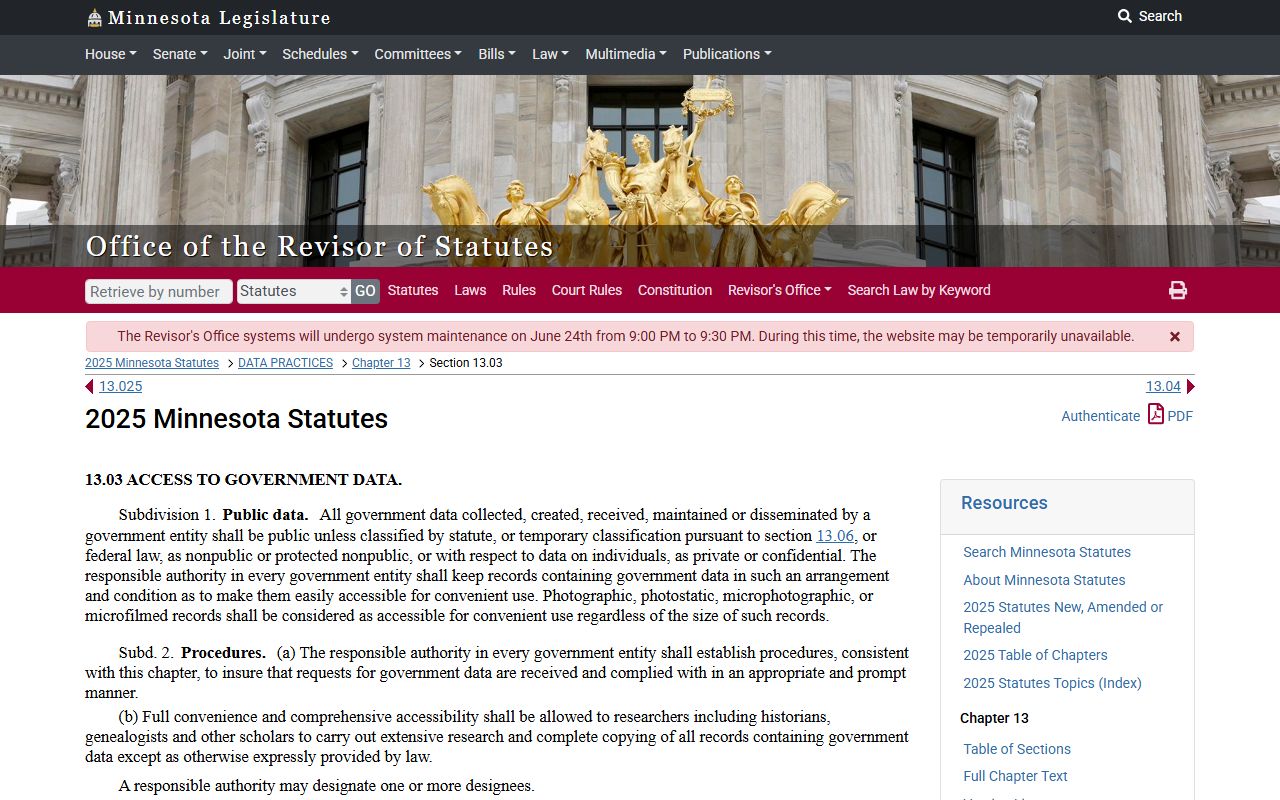
That distinction helps separate District Court case files from county attorney, sheriff, jail, property, and administrative records.
Note: MCRO is official for online access, but Court Administration is still required for certified Dakota County court records.
Restricted Dakota County Court Records
Minnesota Rules of Public Access Rule 4 identifies categories of case records that are not open to the public. Those limits matter in Dakota County for juvenile delinquency, CHIPS, adoption, medical records, court services records, civil commitment materials, some domestic abuse and harassment materials, and records sealed by statute or order. Juvenile files are not searched like adult public files, and Minn. Stat. 260B.171 gives juvenile legal records a separate access rule.
The Rule 4 source page is the core public-access rule for nonpublic Dakota County court record categories.
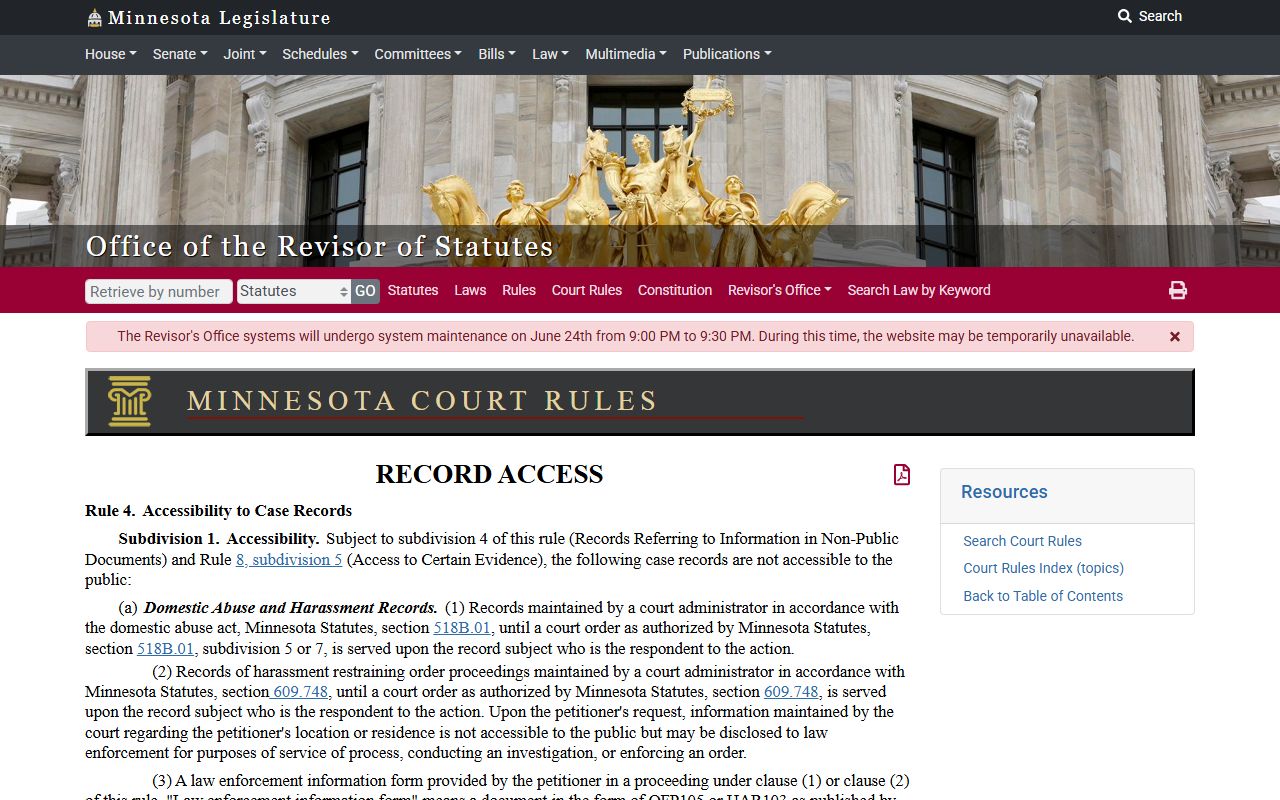
Rule 4 is why a public-facing search may omit whole case categories or documents even when a court case exists.
Rule 8 explains why remote access is narrower than courthouse access. MCRO remote access excludes party street addresses and most comment fields. It also limits internet access to Domestic Abuse/OFP, Harassment Restraining Order, CHIPS, Juvenile Delinquency Felony 16, and public civil commitment documents. Documents filed before July 1, 2015 may also have limited online availability.
The Rule 8 remote-access page helps explain the gap between online Dakota County court records and public-terminal access.
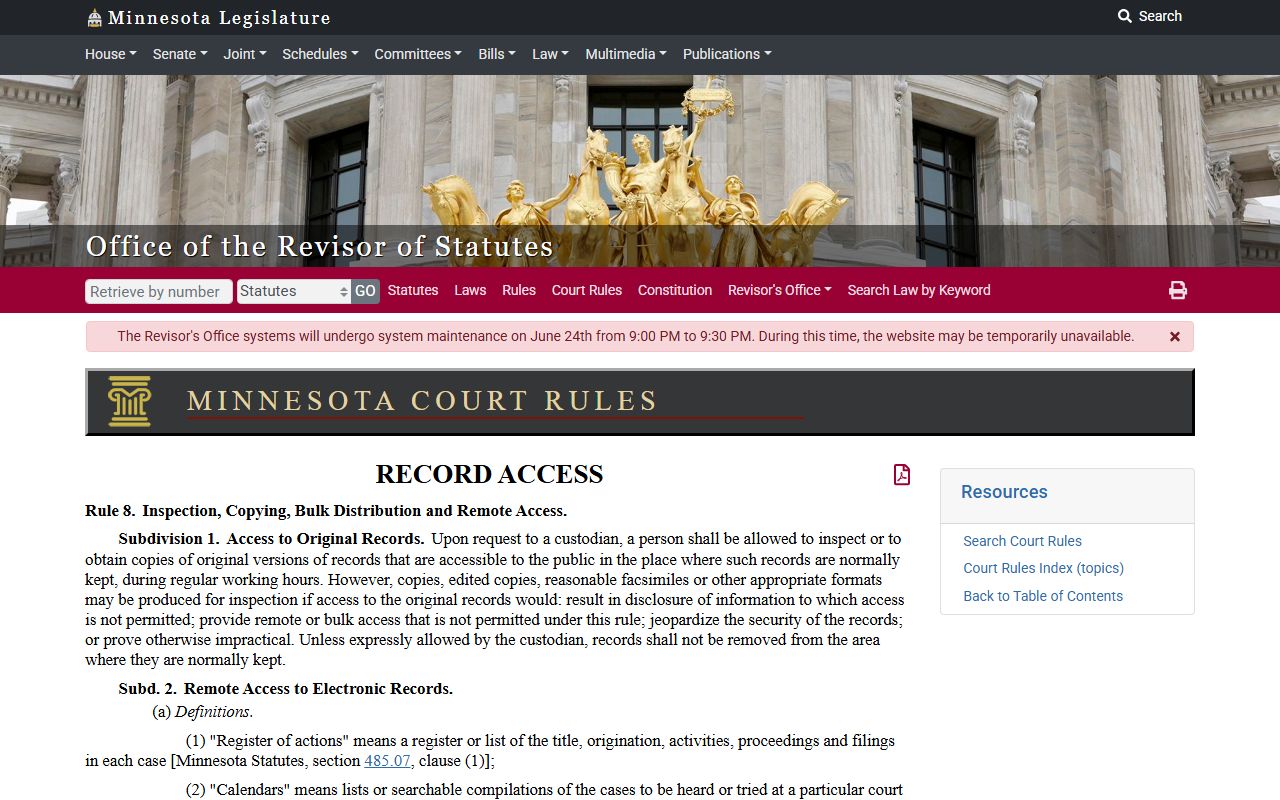
For sealed or expunged matters, contact Court Administration or use the appropriate court forms because ordinary public search tools will not show the full file.
Dakota County Court Record Requests
When online access is not enough, Dakota County District Court Administration can help with certified copies, older records, public-terminal access, and questions about hearings or files not visible in MCRO. The Minnesota Judicial Branch lists three Dakota County court locations. The Hastings Judicial Center is the primary court location, with additional court service locations in Apple Valley and West St. Paul. Business hours are 8:00 a.m. to 4:30 p.m., Monday through Friday.
Bring the case number when possible. If the case number is unknown, provide the full party name, approximate filing date, case type, and any known citation number or attorney name. For county-maintained data rather than court case files, Dakota County public data requests route to the County Attorney's Office for attorney data and to the county Data Practices Compliance Official for other county data.
Court Administration
1560 Highway 55
Hastings, MN 55033
651-377-7180
8:00 a.m.-4:30 p.m., Monday-Friday