
Dakota County Court Dockets
A court docket is the case activity log and hearing schedule attached to a court file. In Dakota County, the docket is produced by Dakota County District Court because Minnesota District Court is the trial court of general jurisdiction for civil, criminal, family, probate, juvenile, traffic, eviction, and conciliation matters. The docket can show when a complaint was filed, when a hearing was set, what type of hearing is scheduled, which judicial officer is assigned, whether orders or notices were entered, and whether a case is active, inactive, disposed, or awaiting another event.
Dockets differ from full court records. The docket is a structured list of case activity. The full case record may include pleadings, affidavits, exhibits, orders, notices, financial entries, and downloadable public documents. MCRO may show both docket entries and public documents in some case types, but remote document access is limited by case category, filing date, and Minnesota public-access rules. For Dakota County court dockets, the key sources are MCRO Hearing Search, MCRO Case Search, and the Dakota County daily calendar PDF.
Find Dakota County Dockets Online
The fastest route for hearing information is MCRO Hearing Search. It can be used to search Minnesota District Court hearings by available party, case, judge, attorney, or calendar-related fields, then narrow the location to Dakota County. For broader case activity, MCRO Case Search shows the Register of Actions. For same-day courthouse schedules, the Judicial Branch posts a Dakota County daily calendar PDF.
- Open MCRO Hearing Search and accept the terms if prompted.
- Enter the party name, case number, attorney, judicial officer, or other known hearing search information.
- Use court location filters to select Dakota County when statewide results are too broad.
- Review the hearing date, time, location, judicial officer, hearing type, party role, and case number.
- Open MCRO Case Search with the case number when the full Register of Actions is needed.
- Check the Dakota County daily calendar when confirming courthouse hearing schedules close to the hearing date.
Hearing Search is a docket-focused MCRO tool. The research found that Dakota County hearing records can be searched through court, party, case, judge, and attorney-related information, then checked against the daily calendar when timing is critical.
| Search Field | Type | Use | Dakota County Note |
|---|---|---|---|
| Party or name information | Text | Find hearings tied to a person or entity. | Confirm party role before assuming why the person appears. |
| Case number | Text | Find the most precise docket match. | Use Dakota prefixes such as 19HA, 19AV, or 19WS when known. |
| Judicial officer | Text/filter | Locate hearings assigned to a judge or hearing officer. | Assignments can change on the calendar. |
| Attorney | Text/filter | Find matters connected to a lawyer. | Useful when party spelling is uncertain. |
| Court location | Selector | Narrow statewide hearing results. | Select Dakota County or the known Dakota court location. |
The MCRO Hearing Search portal is the primary online search tool for Dakota County court dockets and hearing dates.
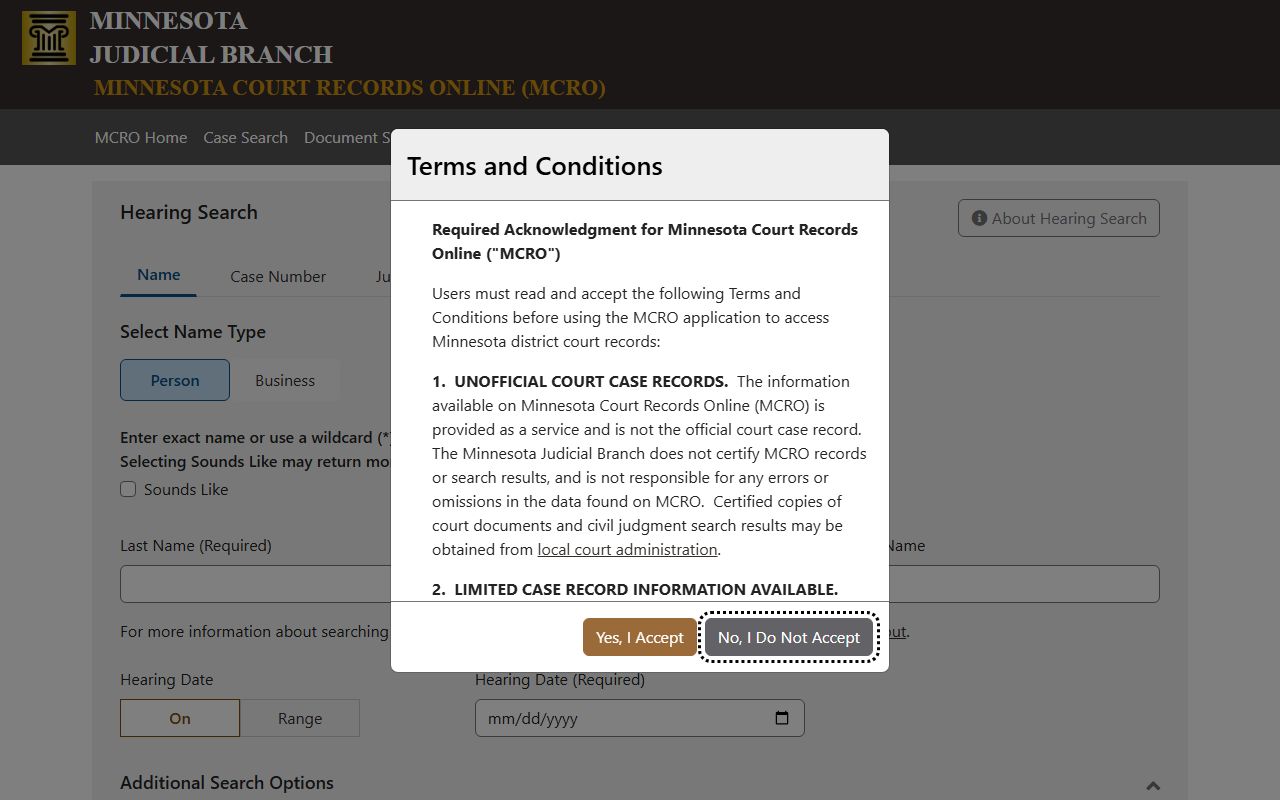
Hearing Search is useful for upcoming activity, but the case docket should still be checked for prior filings, orders, and status changes.
Dakota County Docket Fields
The Dakota County daily calendar sample showed hearing records with party name, location, hearing date and time, judicial officer, hearing type, connection type, party role, and case number. Examples included criminal, civil, conciliation, probate, and traffic/petty case prefixes such as 19HA-CR, 19AV-CR, 19WS-CR, 19HA-CV, 19WS-CO, 19HA-PR, and 19AV-VB. Those prefixes help identify the court location and case type before the full case is opened in MCRO.
| Field | What It Shows |
|---|---|
| Party Name | The public name or entity tied to the calendar entry. |
| Hearing Location | Judicial Center, Western Service Center, Northern Service Center, courtroom, or hearing office. |
| Hearing Date and Time | The scheduled date and start time for the docket event. |
| Judicial Officer | The judge or hearing officer assigned, subject to calendar changes. |
| Hearing Type | Arraignment, omnibus, sentencing, motion, eviction, conciliation, probate, commitment, review, or similar event. |
| Connection Type | The calendar field used for appearance or connection information when listed. |
| Party Role | Defendant, plaintiff, petitioner, respondent, decedent, or another role. |
| Case Number | The Dakota County District Court case identifier used to open the record in MCRO. |
The Dakota County District Court fee schedule is not a docket search tool, but it is often consulted once a docket shows a filing or case type with a fee consequence.
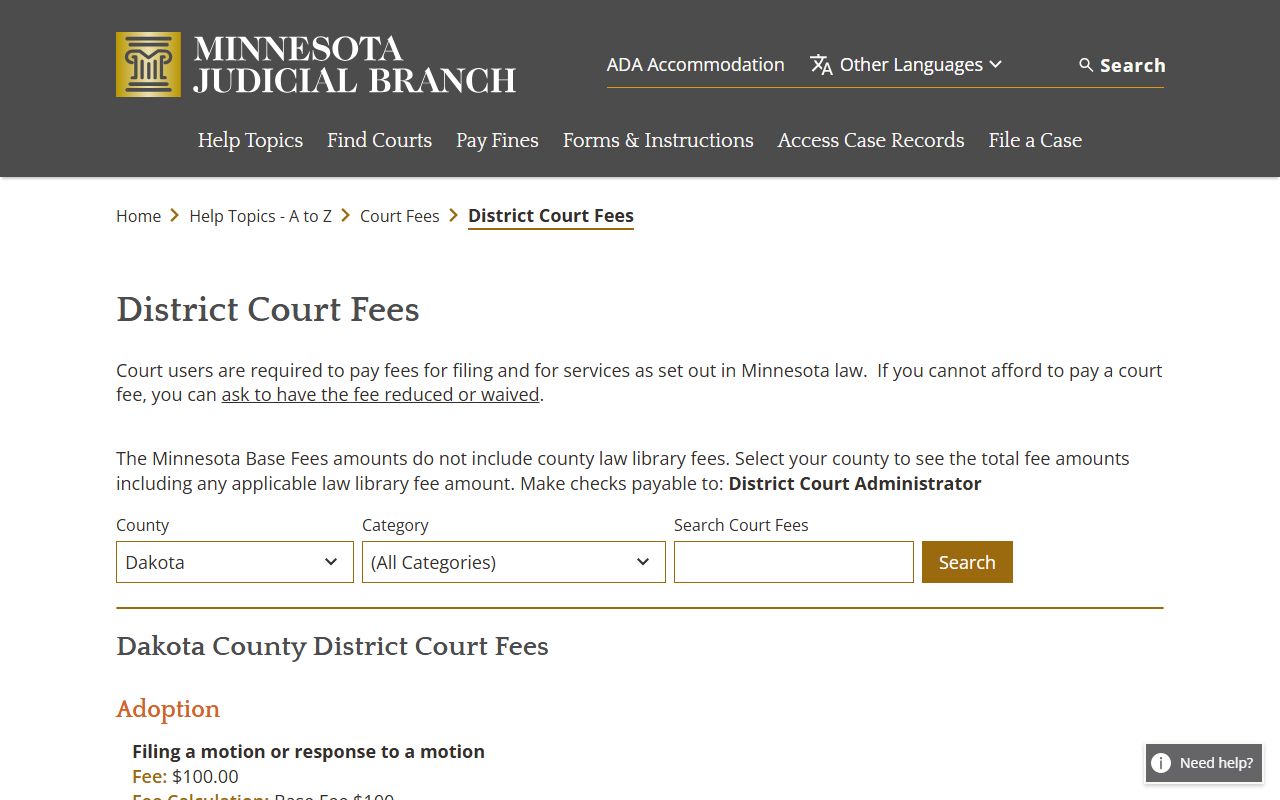
Fees and docket entries answer different questions: one shows cost by filing type, while the other shows what happened in a specific case.
Dakota County Courts With Dockets
Dakota County does not have separate municipal trial courts, county courts at law, or justice-of-the-peace courts for local court records. The District Court is the court that creates the local docket for civil, family, probate, juvenile, criminal, and traffic cases. City police departments may issue citations, and county offices may hold administrative data, but the court case itself is filed in Minnesota District Court. Appeals from Dakota County District Court normally go to the Minnesota Court of Appeals, with limited further review by the Minnesota Supreme Court.
- Dakota County District Court creates trial-level dockets for civil, family, probate, juvenile, criminal, traffic, eviction, and conciliation cases.
- The Minnesota Court of Appeals reviews many appeals from District Court and agency or local-government decisions.
- The Minnesota Supreme Court is the final state appellate court and statewide rules authority.
- Tax Court and Workers' Compensation Court of Appeals are specialized state tribunals, not Dakota County local trial courts.
Because the trial-court docket is centralized in District Court, the local question is usually which Dakota County location is tied to the case number or hearing location. Hastings, Apple Valley, and West St. Paul court locations can all appear in docket information. Public access still depends on case type and rule-based limits.
Docket vs Case Record
A docket entry is a signal. It says that something was filed, scheduled, heard, continued, ordered, or disposed. A full case record adds the supporting documents and the official court file. In Dakota County, the difference matters most when a user sees a hearing type or disposition line and needs to know the legal effect. The docket might say "Sentencing" or "Motion Hearing"; the full file may contain the sentencing order, motion papers, exhibits, and judge's order.
| Issue | Docket | Full Case Record |
|---|---|---|
| Format | Chronological list of events and hearing entries. | Case details plus filings, orders, notices, and available documents. |
| Best use | Track timing, hearing status, and case movement. | Read legal claims, orders, dispositions, and certified case proof. |
| Access | Often visible through MCRO or daily calendars. | May require Document Search, Court Administration, or courthouse access. |
| Limits | May not explain the substance behind an event. | May include records that are restricted, sealed, or not remotely available. |
For example, a criminal docket may list arraignment, omnibus hearing, contested omnibus, sentencing, probation violation, warrant event, or motion hearing. A civil docket may list complaint, answer, motion for summary judgment, eviction hearing, conciliation hearing, judgment, or satisfaction. A probate docket may list probate hearing, petitioner, decedent, and case number, while the actual filings may be accessed only when public and remotely available.
Read Dakota County Dockets
Start with the case number. Dakota County calendar examples use prefixes that point to local filing locations and case types. A CR case is criminal, CV is civil, CO is conciliation, PR is probate, and VB is commonly tied to traffic or petty matters. The party role tells whether the named person is a defendant, plaintiff, petitioner, respondent, or decedent. The hearing type tells the procedural stage, not always the outcome.
Some terms need plain reading. Arraignment is the early criminal hearing where charges are addressed. An omnibus hearing is a Minnesota criminal pretrial hearing that can address probable cause, evidence, motions, and trial readiness. A continuance means a hearing or deadline was postponed. Disposition means the present or final outcome of a case or charge. Judgment means an enforceable court decision, including money judgments. Register of Actions means the chronological docket list.
Note: Hearing dates and judicial assignments can change, so verify Dakota County court dockets close to the hearing date.
Dakota County Docket Help
When a docket entry is unclear, use the official access path tied to the question. MCRO can show the Register of Actions and available public documents. Hearing Search can confirm scheduled hearings. The daily calendar can show same-day or near-term court settings. Court Administration can help with certified copies, older files, and records that are not visible online. Jail court-time questions from Dakota County jail materials point to District Court at 651-377-7188, while general District Court Administration is listed at 651-377-7180.
Court Administration
1560 Highway 55
Hastings, MN 55033
651-377-7180
8:00 a.m.-4:30 p.m., Monday-Friday
For county executive-branch data, such as sheriff or county attorney records related to a case but not part of the court docket, Dakota County Data Practices routes are separate. Court docket questions should stay with Court Administration or MCRO.